Why I've stopped chasing GMV growth
Originally written in Chinese. Translated with AI, reviewed by Gary. Read the Chinese original →
Yesterday I met two very successful business owners in Malaysia. One is a big name in e-commerce. The other is in food: they did very well online, and in the past few years have been shifting their focus offline.
We talked about a problem many e-commerce brands face right now: marketplace commissions keep going up, and with all the Shopee, TikTok and Lazada fees added together, business keeps getting harder. So what should we do next?
I offered a view that was maybe a bit different.
Don't scale.
What I meant was simple. If marketplace fees are this high, why keep pushing so hard for GMV growth? Get ads under control, cut the sales that don't make money, and even if GMV ends up lower, as long as the business makes money, isn't that fine?
The growth habit the pandemic left behind
I think this has a lot to do with the habits the whole e-commerce industry formed during the pandemic years.
The market was suddenly thrown off balance. Consumers moved online in huge numbers, and marketplaces exploded. Many brands could get more orders just by being willing to spend on ads. More orders meant more inventory, more SKUs, more staff, more live rooms, and then pouring the money back in to chase even bigger scale.
That model really did work back then. We went through that stage ourselves.
Slowly, everyone formed a habit: RM10 million this year, RM20 million next year, ideally RM30 million the year after. Grow every year; GMV must keep getting bigger.
But have we ever seriously asked why GMV has to grow?
When platform fees were low and traffic was cheap, scaling up might really have brought more profit. But things are different today. Commission, ads, affiliate, vouchers and transaction fees stack up layer by layer, and very often sales go up while profit doesn't follow.
Another friend in fashion told me about his ads on Meta.
His ROAS used to be 10: spend RM1 on ads, and the ads dashboard attributed RM10 in sales. As competition grew, it slowly dropped to 3.5, and now it's fairly stable at around 3 to 3.5.
What's more interesting is that when he tried increasing his ad budget, sales barely grew, but ROAS could drop to 2.
If actual sales aren't growing and you keep raising the ad budget, what value is that extra money creating?
It made me rethink whether the growth strategy we got used to still fits today's market.
Decide what you can earn, then how big to be
Some people might ask: if GMV drops, what about inventory? The team? Fixed costs?
My view: if there's too much inventory, control buying and restocking. If there are too many people, adjust the team size, or move people to other channels that can create profit. If a marketplace no longer suits further scaling, put the resources somewhere with better returns.
Why must we keep our existing size, and then find every possible way to make money to support it?
Shouldn't we first work out how much this business can earn, and then decide how big it needs to be?
Of course, I'm not saying every brand should stop growing. If an extra RM100,000 in sales earns me an extra RM10,000, of course I'll keep scaling. But if an extra RM100,000 in sales makes me RM5,000 less, why would I do it?
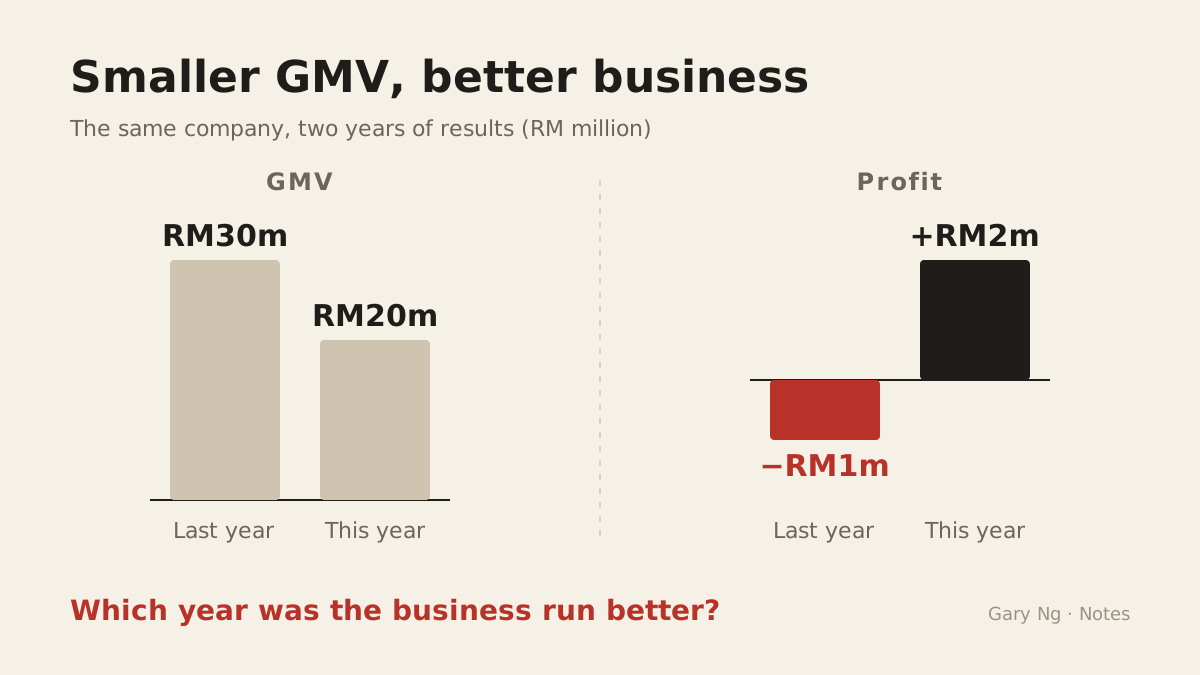
Especially once a company reaches a certain size, GMV easily becomes a burden. RM30 million last year, and only RM20 million this year, looks like going backwards.
But if last year you did RM30 million and lost RM1 million, and this year you did only RM20 million but made RM2 million, which year was the business actually run better?
After all these years in e-commerce, through fast growth, expansion and fundraising, and through pressure on inventory and cash flow, I increasingly feel a company shouldn't grow just for the sake of growing.
Marketplaces still have opportunities. Shopee, TikTok and Lazada can still make money. We just don't have to push every channel to its maximum, or accept thinner and thinner margins to hit a GMV target.
We used to decide how much GMV to do first, and then figure out how to make money.
Now we decide how to make money first, and then think about how much GMV to do.
Knowing when to stop
I used to think a bigger business meant a more successful one. Looking back now, I think what matters more is knowing when to scale up, when to stop, and even, when necessary, to deliberately make the business smaller.
This isn't something I suddenly figured out on my own.
Over the past year or two, I've had the chance to talk with and learn from quite a few very successful entrepreneurs in their sixties. I slowly noticed that they don't only know how to grow a business. More importantly, they know when to push, when to hold, and when to stop.
I think that judgment is a very important business skill too.
After all, we start companies to build something that can last, something sustainable, not to hand in a prettier GMV report card every year.
This piece also appears on the Labu-Labu Blog.