It turns out I wasn't drawing an organisation chart
Originally written in Chinese. Translated with AI, reviewed by Gary. Read the Chinese original →
Yesterday at TEDxPetalingStreet, one of the speakers, Li Jiada from Taiwan, suddenly answered something I hadn't been able to figure out for years.
Emergence
He's the founder of a school called 世界观学院 (roughly, "Worldview Academy"), and he shared a fascinating idea called emergence.
Why can thousands of sardines change direction in the sea at the same moment without crashing into each other? Why can tens of thousands of birds form all kinds of complex shapes in the sky, looking as if someone is directing them, when in fact no single bird is leading the flock?
Each bird and each fish simply keeps adjusting its direction based on what the ones around it are doing. None of them knows what shape the whole group will end up making, but when a large number of individuals keep interacting, an overall order forms naturally.
That's emergence. Put simply, many individuals, through their connections and interactions, produce a result that no single one of them could achieve, and that nobody necessarily designed in advance.
He also shared a very interesting experiment.
In 1991, at an event at SIGGRAPH, computer graphics researcher Loren Carpenter had an audience of about 5,000 people play Pong together, the early video table-tennis game.
Each person held just one card, red on one side and green on the other. The audience was split into two halves, and each half jointly controlled the paddle on one side of the screen. The computer moved the paddle up or down based on the proportion of colours being held up.
The fun part is that no one could control the paddle alone, and no one could tell the thousands of people in the room what to do.
But everyone could see the ball on the screen, and everyone knew the goal was to hit it back. So each person kept adjusting what they did, and slowly, thousands of people really could play the game together.
The most interesting thing is that thousands of people didn't need to do exactly the same thing to achieve the same goal.
An organisation chart that looked like a mess
Hearing this, I suddenly remembered an organisation chart I drew a few years ago.
About three or four years ago, we were dealing with some financial institutions, and they asked for our company's organisation chart.
My first thought was: our whole team is just over a dozen people. Do we really need an org chart?
Basically everyone knew what they had to do. If there was a problem, they went straight to the right person, and a lot of things could start as soon as I arranged them. Splitting into departments, deciding who reports to whom and who approves what: wouldn't that just add work for everyone?
But since they asked, I had to look into it properly.
During that time I studied how companies like Apple, Google and ByteDance manage, and looked at OKRs, KPIs and how different companies design their structures.
After all that, I felt these things made sense, of course, but didn't quite fit a team of a dozen people like us.
In the end I took a blank sheet of paper and drew my own organisation chart.
Besides the CEO, COO, CPO, CSO and the different departments, I drew two kinds of lines. One was the normal reporting line. The other showed where departments needed to communicate and collaborate directly.
For example, we're an apparel company. The Product and Merchandise team develops products, buys and restocks, and is one of the departments that uses the most money.
If every purchase had to go up layer by layer to me for approval, and then back to Finance, wouldn't that waste a lot of time?
So I set up a direct working relationship between Product and Finance. What needs discussing gets discussed directly, approvals that are needed stay in place, but not everything has to go through me as CEO.
Another example is the sales team.
Our sales force is mainly livestream hosts. They face customers every day, and they're the people who know most directly what customers like and don't like, what prices sell, and what content draws viewers in.
So besides reporting to sales management, I wanted them to work directly with the Marketing and Content teams, carrying the feedback from the live room to the other departments.
And so my organisation chart had, on top of the normal reporting lines, a whole bunch of dotted cross-department collaboration lines.
The whole thing looked like a complete mess. 😂
But I didn't think too much about it at the time. I felt it was a more efficient way to work, so that's what I handed in.
I never expected that this way of working would last for years.
Over those years, the company slowly grew from a dozen people to more than fifty. Recently, while planning the next three years, we took this organisation chart out again to discuss how the team might grow from 55 people today to 107.
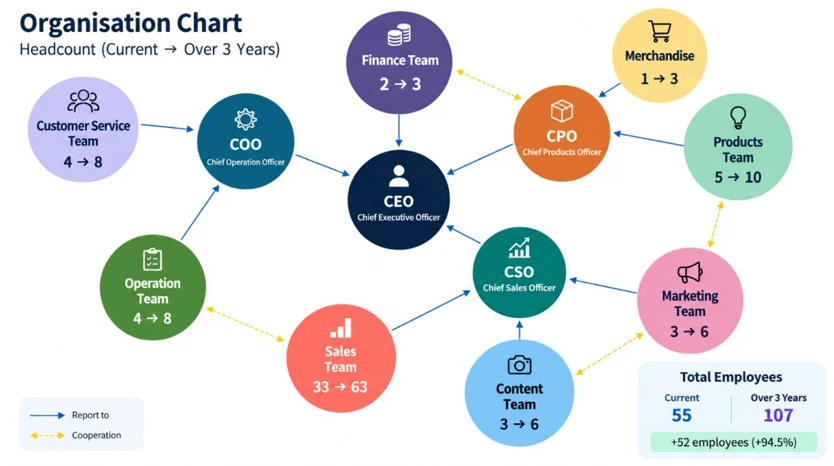
Looking at that chart, still full of lines, I'd always had one question.
Why could a structure that doesn't really follow traditional management work like this for so many years?
Only yesterday, hearing Li Jiada explain emergence, did it suddenly click: what I'd been trying to build all along may not have been a traditional organisation chart, but a system that lets people connect, collaborate and solve problems on their own.
The words on the wall
Looking back, I've always wanted to turn the company into a platform where young people get the chance to achieve their dreams.
I even put a big slogan on the office wall:
"Capai Impianmu, Teruskan Berusaha!"
Achieve your dreams, keep working hard!
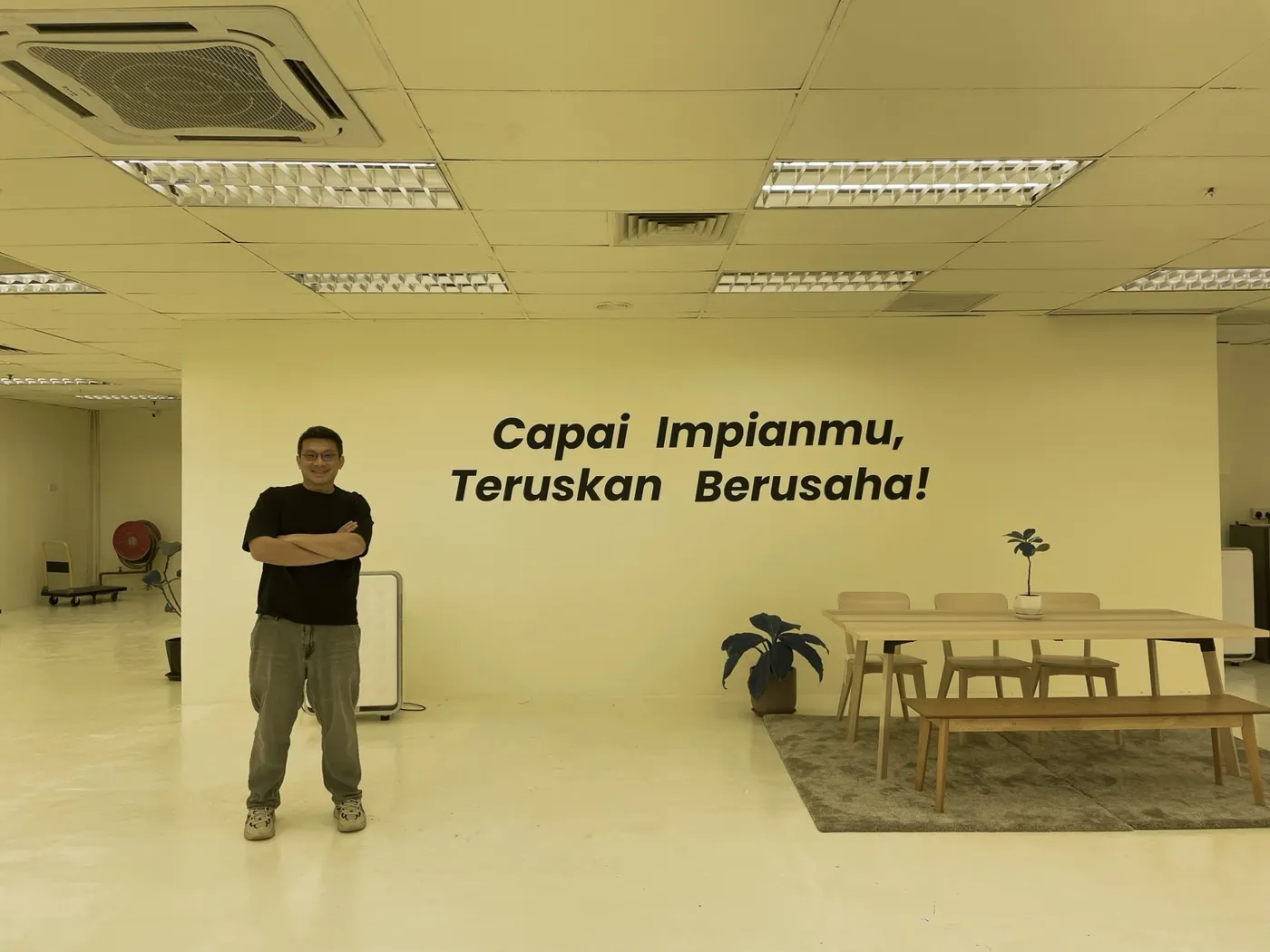
Those words weren't put there casually.
My partners and I have always felt that besides earning a salary, people go to work hoping to make their lives better. Some want to buy a car or a house, some want a better income, some want to learn something new, and some want to prove what they can do.
Everyone's dream is different, and I can't decide for them what success means.
But I hope the company can be a platform where everyone has the chance, through their own effort, to build the life they want.
So I don't like to get involved in everything myself. For many small projects, as long as the direction is clear, I'd rather let the team try things on their own.
If they need resources, they go to the relevant department. If they hit a problem, they find the people who can solve it with them. As long as they stay within the company's rules and budget, they can figure out how to get things done.
Slowly, the team started forming its own ways of working together. Some workflows weren't designed by me, and some solutions weren't my ideas. They came from people working together, making mistakes and adjusting, again and again.
Looking back now, isn't that a bit like thousands of people playing Pong together?
Everyone moves differently, but they all know what the shared goal is.
And in a company, we don't necessarily share the same life dreams, but we can be connected by shared work goals, and in the end create something none of us could have done alone.
Emergence isn't a free-for-all
Of course, this way of working has its problems. Sometimes there are misunderstandings, sometimes departments clash, and not every project succeeds.
And emergence doesn't mean that if you just put a group of people together and give them freedom, good results will appear by themselves.
As with the Pong game: if people don't know the goal, can't see where the ball is, and can't tell whether their last move had any effect, then no matter how hard thousands of people try, it would be very hard for them to return the ball together.
So I've started to think that what really holds this kind of organisation up may not be the organisation chart itself, but a few more important things.
Do people share a goal? Can they find the people they need to work with? Do they have enough information to make decisions? After acting, can they quickly see the result and keep adjusting?
Of course we still need an organisation chart. Especially as the company grows, we need to know who is responsible for what, who has decision rights, and who is accountable when something goes wrong.
It's just that I think an organisation chart should define responsibility, not limit collaboration.
This is also where I'm thinking about how to manage the company in its next stage.
When we were a dozen people, a lot could be solved through trust and unspoken understanding. But today we're more than fifty, and if we really grow past a hundred, we can't keep relying on everyone knowing each other, or on people coming back to me every time there's a problem.
We need clearer shared goals, more transparent data, clearer decision rights, and ways for different teams to keep communicating and learning.
When I used to study OKRs and KPIs, I always thought of them as tools big companies use to manage people. But seen from another angle, maybe their bigger value is letting the whole team see which direction it's heading, and whether what it's doing is actually hitting the goal.
Like the Pong game: everyone needs to see the same screen to keep adjusting their moves.
Organisations in the AI era
And as we move into the AI era, this may get even more interesting.
In future, collaboration in an organisation won't only be between people. It may also be between people and AI agents, or even between different AI agents.
The information each department holds, whether Product, Sales, Marketing or Finance, can be connected much faster through data and AI. People will still make the judgments and take responsibility, but they won't need everything to go up and down the layers just to get the information they need.
Then a manager's job may no longer be only assigning tasks and supervising, but designing an environment where people can collaborate on their own and keep learning without losing direction.
Of course, I don't think my past way of managing is proven right just because it happens to fit some theory.
Instead, yesterday's talk helped me understand more clearly what I got right, and what still needs to improve.
Especially as the team keeps growing, I need to think harder about how to make this way of working stop depending on me personally, and become something the whole organisation can sustain on its own.
Looking back, a few years ago I drew lots of dotted collaboration lines simply because a traditional organisation chart didn't seem to fit a team of a dozen people.
Back then I'd never thought about complexity theory, and didn't know what emergence was.
I just felt that this way, things got done faster, and people could find resources more easily.
Only after a few years did I slowly see what those connections had produced.
Yesterday after the talk, looking back at that chart and the words on our office wall, it all felt rather interesting.
It turns out what I wanted to draw back then wasn't just a structure of who manages whom, but how a group of people heading in the same direction can each use their own abilities and, through their connections, get things done together.
Maybe what we need to think about in future isn't only how to draw a more complete organisation chart, but how a growing organisation can keep producing good results even when no one is directing it every moment.
And as a founder, I've started to feel that my job shouldn't always be standing in the middle, telling everyone what to do next.
It should be making sure that even without me in the middle, everyone can find their direction, find each other, and get things done together.
That's probably the biggest lesson the idea of emergence gave me yesterday.