BookXcess doesn't just sell books
Originally written in Chinese. Translated with AI, reviewed by Gary. Read the Chinese original →
Today I went to NEXEA's Entrepreneur Camp.
What's special about this kind of camp is the chance to do team building, chat and swap notes with a big group of founders. In the evening there's a very special segment: everyone gathers around a bonfire on the beach, and experienced entrepreneurs are invited to share.
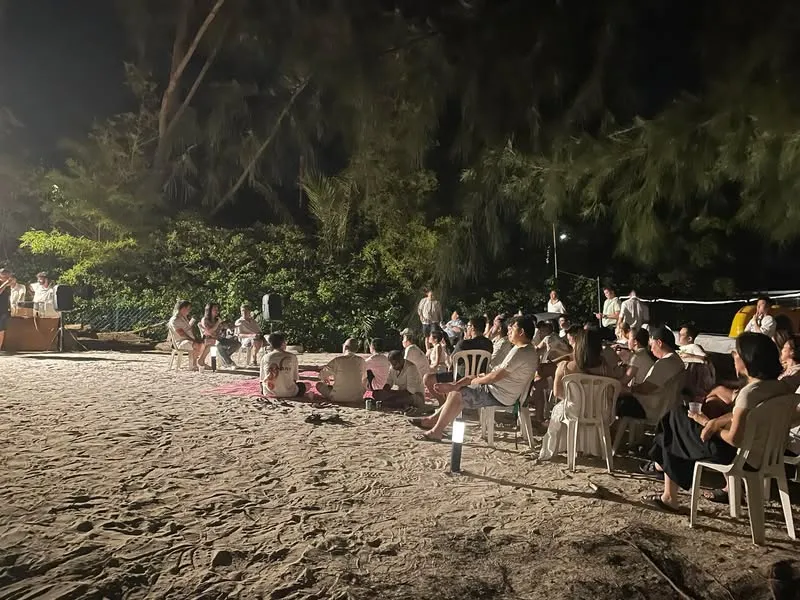
NEXEA went to real effort today and brought in Andrew Yap, founder of Big Bad Wolf and BookXcess, and Malik Ali, founder of BFM.
I want to start with Andrew Yap's talk, because it was genuinely inspiring.
Andrew wasn't someone who loved reading to begin with. He said himself that he isn't highly educated, that when he was young he was more into cars, and that he once ran a car workshop on Old Klang Road.
Later, a friend introduced him to some books and asked whether he wanted to buy them to resell. That's honestly how simple the start was.
But as he went along, he formed a very clear idea:
He wanted to do affordable books.
To let ordinary people, most people, be able to afford books.
That idea became Big Bad Wolf, and then BookXcess. Today the company has passed a hundred million in revenue and gone into more than ten countries.
Drawing in people who don't read
But what I found most interesting isn't just that he grew it big.
It's how he understands what a "bookshop" is.
Someone asked him why BookXcess stores are so beautiful. Lovely fit-outs, coffee, seats, power sockets, air-conditioning, and people are allowed to sit for a long time.
From a traditional retail point of view, this is hard to justify.
Because many people in business today are calculating ROI. How much each square foot must earn. With that much spent on fit-out, when will it pay back?
But Andrew's answer was unusual.
He said Malaysia doesn't actually lack bookshops. People who really love reading will naturally go looking for books, and they'll find cheaper ones too.
So his goal isn't only to sell books to people who love reading.
His goal is to draw in people who don't read.
You can come to take photos. You can come for coffee. You can come for the air-con. You can sit down to do homework or open your laptop. If you don't buy a book the first time, that's fine.
Because as long as you're willing to walk in, you have a chance to come into contact with books.
Maybe you don't buy the first time, or the fourth time, or even the twentieth time.
But one day, sitting there, you see a book, flip through it, suddenly feel interested, and take it home.
To him, that makes it worthwhile.
I think that's a very special way of thinking.
In an era when everyone talks about efficiency, conversion and ROI, he uses experience to do retail.
He doesn't push you to buy from the start.
He first lets you come in, first lets you like the place, first lets you get used to books being around.
That really inspired me.
Because many businesses don't close the sale in the first second.
In some businesses, you first enter the customer's life and let them get a feel for you, and then one day, they buy.
Resilience
Later, someone asked him how he got through the hardest time in his business.
He said it was the pandemic.
Shopping malls couldn't open, book fairs couldn't be held, and the company happened to be expanding, carrying heavy debt of around RM220 million. Lots of books were sitting in a warehouse at Westport, and the rent alone was RM600k a month.
That kind of pressure is no joke for a founder.
But he said one word:
Resilience.
During the pandemic, many malls had lots of empty units. So he went to the malls and said: since you have empty space, why not let me move my books in and open a store?
For the malls, having a tenant was better than leaving it empty. For him, the books could move again and the rent pressure could be solved in a new way.
After the pandemic, the situation turned around completely. Now you see Big Bad Wolf and BookXcess blooming in many places.
The same pile of books is a cost when it sits in a warehouse. Put it in a mall where people walk in, and it becomes an opportunity.
That's a founder's resilience.
The most expensive word: later
Finally, he shared two very simple but important points.
He asked everyone:
What causes a business to die?
If you could name only one thing, what would it be?
His answer was cash flow.
No matter how big your revenue is or how successful you look, once the cash flow is gone, the company dies.
The second question:
What is the most expensive word in business?
His answer: later.
In a while. A bit later. We'll do it afterwards.
Very often, the most expensive thing isn't rent, salaries or ad spend.
The most expensive thing is "later".
Because as you keep putting things off, a small problem becomes a big one, and something you could have fixed right away ends up costing you dearly.
Honestly, I used to see BookXcess as just a very pretty Instagram-friendly bookshop, great for photos.
But after hearing Andrew today, I realised that's not it.
Behind it is a founder's very clear thinking.
He knows why he does books. He knows why he wants affordable books. He knows why he makes his bookshops so beautiful. And he knows he isn't only selling books to people who love reading, but drawing in people who don't read.
That's rare.
Because truly good entrepreneurship isn't just about selling a product.
It's knowing very clearly what you actually want to change.
BookXcess doesn't just sell books.
It sells ordinary people a way in to books.