A popsicle-stick bridge, and starting up in the age of AI
Originally written in Chinese. Translated with AI, reviewed by Gary. Read the Chinese original →
Yesterday I posted about Entrepreneur Camp, and a few friends messaged me privately to ask:
"So what exactly is NEXEA Entrepreneur Camp?"
It's actually a fun story.
A few years ago, maybe three or four, I was still looking for investors. I stumbled on NEXEA's Entrepreneur Program. I saw VCs and investors involved and thought, hey, maybe I can raise money here. That's how I ended up in it, more or less by accident.
Once I was in, I realised it wasn't what I'd imagined.
It isn't the kind of event where you pitch and investors hand you money on the spot. It's more of an entrepreneur community. The easiest comparison is something like Vistage, except that it's made up mostly of people who are actually running businesses.
There are startups, family businesses, traditional trades, and some companies that are already doing well. Everyone's background is different, but what they share is that they're all entrepreneurs.
That's why I've stayed with it ever since.
Every year they run an Entrepreneur Camp. I think the purpose is simple: put different founders together, let them talk, get to know each other, do team building, and along the way see how other people think.
Picture what it's like when a hundred-plus founders get together.
Everyone has ideas, everyone is creative, everyone is a boss, and everyone thinks their way can solve the problem. When ordinary people get together, they chat and eat. When founders get together, three minutes in they're discussing business models, five minutes in it's market size, and ten minutes in they're working out how to monetise.
It's quite a sight.
One-person companies really are different now
This year, one feeling hit me hard.
The previous times I went, many people's businesses were already up and running. They came to camp mostly to network, relax and do team building.
This year, one thing was obvious.
A lot of people had been working at big corporates and decided to go out on their own. Many of them are one-person companies, and a lot of them are working on AI, the hottest topic right now.
I met one friend who is also doing it alone, but he has already turned his idea into a product. He does AI voice.
When you first hear "AI voice", you might think: another AI project? Aren't there too many of those already?
But his isn't just talk.
Imagine a bank calling you in the future, speaking very natural Malay, with a voice, tone and responses that feel completely human, but it's actually AI behind it.
More importantly, he already has real customers. Corporates are already using his service.
That's what I find interesting.
We used to talk about one-person companies as more of a concept. But with AI, a one-person company really is different now. One person can build the product, make the demo, do sales and handle delivery. Much of what used to need a team can now get off the ground with one person plus AI.
Thirty minutes for what took me six months
Another part of the camp genuinely surprised me.
They split nearly a hundred people into thirteen groups, each run like a company, with a CEO, a CFO and team members. Over two days, we scored points by completing different tasks.
One of the tasks was to build a dashboard with AI.
It's hard to imagine: thirteen companies, each holding a five-minute meeting to decide what product to build, then half an hour to build the dashboard, then presenting it on stage.
And they actually did it.
Thirteen dashboards, in just over thirty minutes, vibe-coded into product demos using fake data.
What hit me most was that this was very similar to something I paid to develop three years ago.
Three years ago I built a dashboard-style platform that pulled different data together. It cost me nearly RM80,000 and took six months.
Today, with AI, you can make a presentable demo in thirty minutes.
Of course, it's not a real, finished product yet. But the speed, and the imagination, are on a completely different level.
What's even crazier is that the person handling it in our group was a 19-year-old university student. He said studying was boring, so he was starting a business while still studying.
Watching a 19-year-old ask the AI, tweak, build and ship as he went, you suddenly feel the world has really changed.
When we hit a problem in the past, we'd hold a meeting, look for a developer, or wait for someone to reply.
Now when many founders hit a problem, their first instinct is to pick up their phone. Some use Claude, some use ChatGPT, some use Gemini. Nobody sits there complaining about a lack of resources. They go straight for a solution.
To me, that scene was even more striking than the dashboards themselves.
Because you realise the way founders work is changing.
A bridge covered in tape
There was also a team-building game that really stayed with me.
We had to build a bridge out of popsicle sticks. Resources were limited, we had to buy our own materials, and then build the bridge. The first round might be 60cm, the second 100cm, and the requirements kept going up.
In the end, our bridge was covered in tape from end to end.
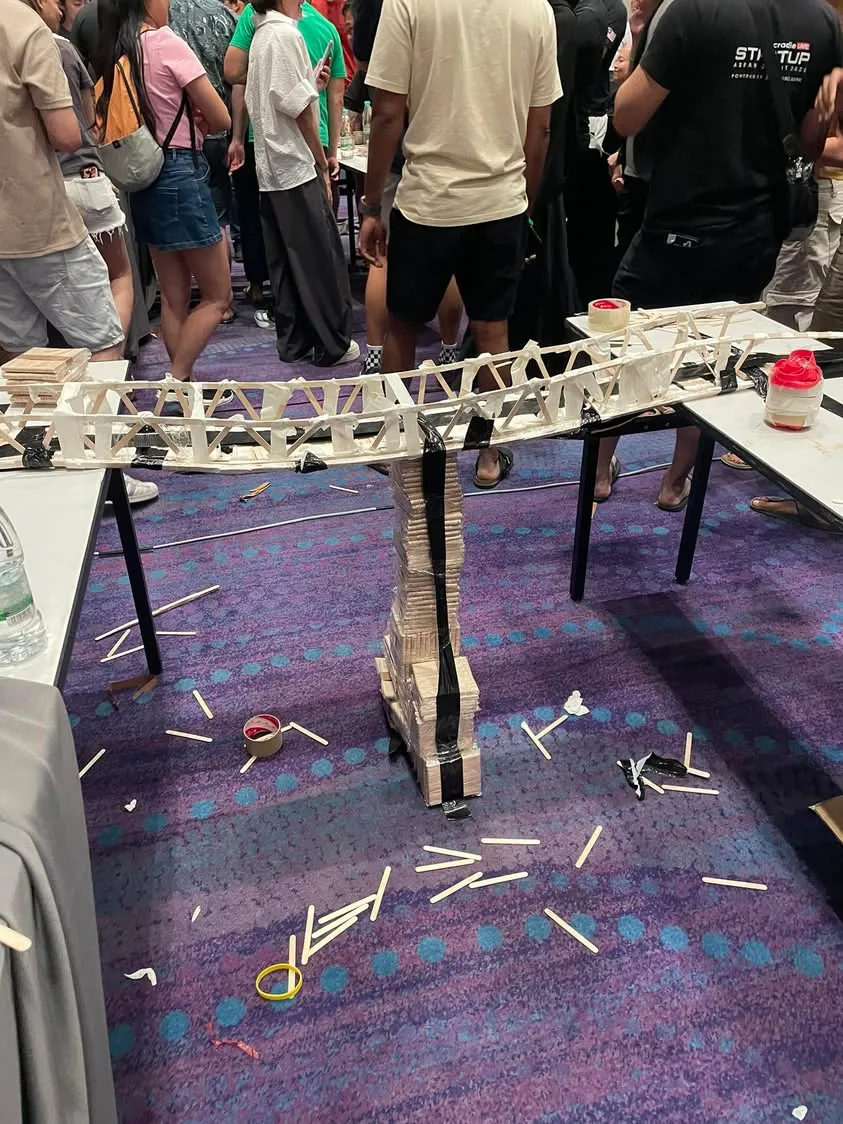
It looked far from perfect, even a bit funny. But it actually held.
Looking at that bridge, I told a friend: isn't that what most companies are like?
At the start it's just one small popsicle stick after another. You think you're building something complete, beautiful and professional, but real entrepreneurship doesn't work like that.
Real entrepreneurship is: you build it first.
Not long enough? Extend it. Not stable enough? Add tape. About to snap somewhere? Prop it up with something more.
Every time you think you won't make it through the round, you somehow scrape through.
When you finally look back, the thing may not be pretty or perfect, and it's full of patches. But it's your company. It's what you held together, round after round, with limited resources.
What I took away most from this NEXEA Entrepreneur Camp wasn't how many people I met or how many talks I heard.
It was a very clear sense that entrepreneurship is entering a new stage.
Starting a business used to need money, a team, technology and resources. Those still matter, but AI has suddenly lowered the barrier for a lot of things.
One person can build a product first.
A small team can test an idea very quickly.
An ordinary founder can use tools that used to belong only to big companies.
But in the end, I think the tools have changed and the essence of building a business hasn't.
You still have to solve problems.
You still need customers.
You still need cash flow.
You still have to build that bridge with limited resources, and make sure it holds.
That's what I find most interesting about NEXEA Entrepreneur Camp.
It isn't just a course, and it isn't just a networking event.
It's more like putting a group of people who are really building businesses in one place. You see how different people think and work, and you see how this era is changing what it means to start a company.
And it reminds you:
Don't just watch the trends.
Get your hands dirty.
Don't just say AI is amazing.
Actually use it to solve problems.
Because the scariest thing about this era isn't whether AI will replace people.
It's that some people have already started using AI to speed up, while others are still standing on the sidelines.