So Cili Padi Kampung really is more expensive
Originally written in Chinese. Translated with AI, reviewed by Gary. Read the Chinese original →
I just went grocery shopping at NSK and noticed something today I had never paid attention to before.
Cili Padi Kampung really is a lot more expensive than ordinary cili padi.
I saw two signs side by side: Cili Api Hijau at RM9.90/kg, and Cili Padi Kampung at RM17.99/kg. Do the maths and it's about 82% more.
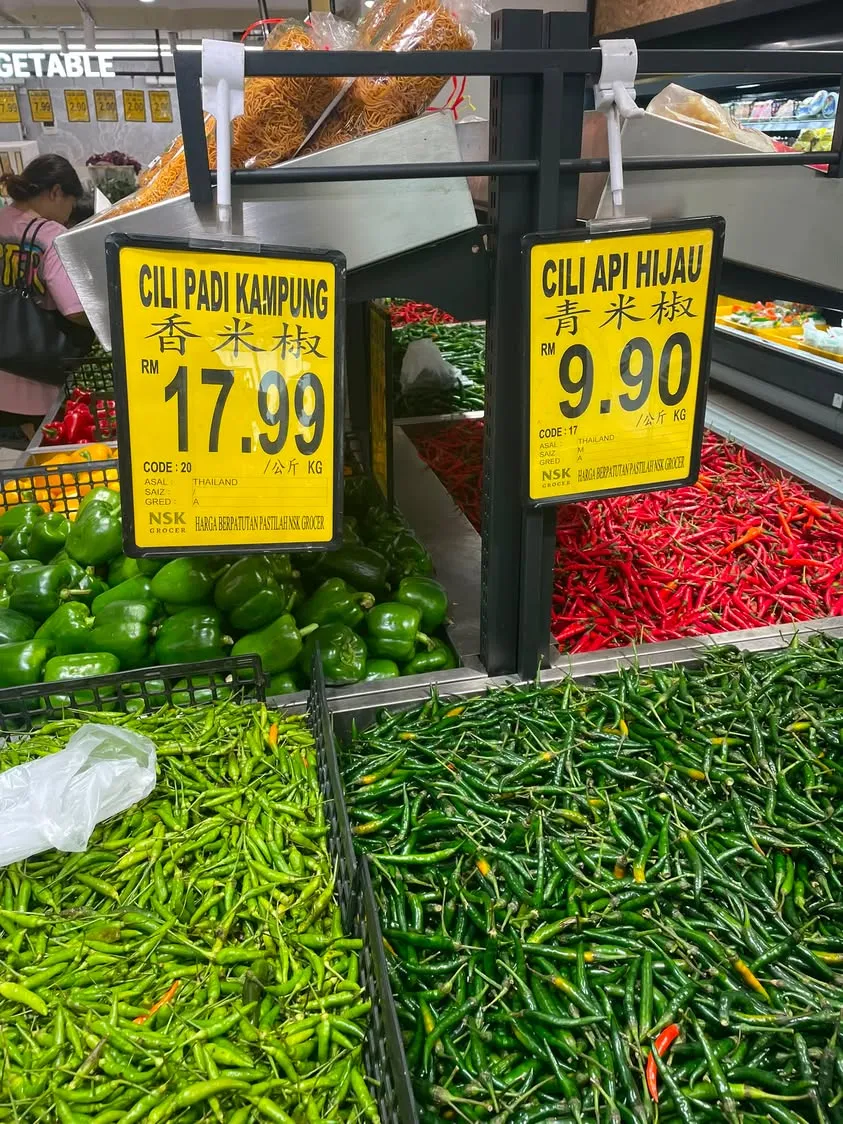
My first reaction was: could one be local and the other imported, which would explain such a big gap?
But looking more closely, both signs said Thailand.
Now that's interesting.
I looked it up and found that this price gap isn't set by NSK. DOSM's agricultural price data already tracks different types of cili padi separately.
Using 2021 data, Thai Cili Padi Akar averaged about RM8.60/kg wholesale and RM11.75/kg retail, while Thai Cili Padi Kampung was already RM13.25/kg wholesale and RM18.30/kg retail.
In other words, the premium already exists before the chillies ever reach the supermarket shelf.
Why?
One very important reason, it turns out, is productivity.
Cili Padi Kampung is smaller. A kilo of it takes a huge number of chillies, and chillies aren't harvested in bulk by machine. They're picked by hand, one at a time.
Some agricultural sources say one of the biggest problems in growing cili padi is picking labour. Because the fruit is small and numerous, picking alone can cost RM5–6/kg. By contrast, Cili Siam, which Malaysia imports from Thailand in large volumes, has bigger fruit, about 3–6cm, so the same workers in the same time can pick a kilo much faster.
The second reason is transport and spoilage.
Commercial chilli varieties are usually larger, turn red later and have sturdier stalks, so they're easier to handle across the whole supply chain from farm to wholesale, transport and supermarket.
Cili Padi Kampung isn't nearly as "industrialised".
It's smaller, harder to pick, and supply is less standardised. Yet many people find it more fragrant, spicier and more flavourful.
So looking back at that RM9.90 and RM17.99, it suddenly makes sense.
A kilo of chillies is a kilo of chillies. How can the price differ by almost double?
Agriculture is like many businesses.
What really determines cost isn't just how many kilos you end up selling, but how much time, labour, loss and efficiency it took to produce each kilo.
Sometimes what we see is the same "product category", but behind it are completely different economics.
The funniest part is that only at the very end did it hit me:
The chillies we grow at home seem to be Cili Padi Kampung.
I used to just think it was nice to have chillies at home.
Now I look at them a little differently.