A million views, and the platform paid me US$56
Originally written in Chinese. Translated with AI, reviewed by Gary. Read the Chinese original →
Let's talk about something fun: my own Facebook.
At the end of March, my Facebook account was banned for no clear reason. I felt I still needed to keep publishing, so I opened a new account and ran it seriously for a month.
After a month: 300 followers.
So I thought, since I'm starting over anyway, why not treat it as a social media experiment and see what kind of content actually takes off?
Then at the end of May, I got the banned account back. I treated it as a fresh start and wrote seriously for 60 days.
Today is exactly day 60. I connected Facebook's API to Claude and ran all the data.
71 posts, 44 long essays, more than a million views, and total earnings of...
US$56.
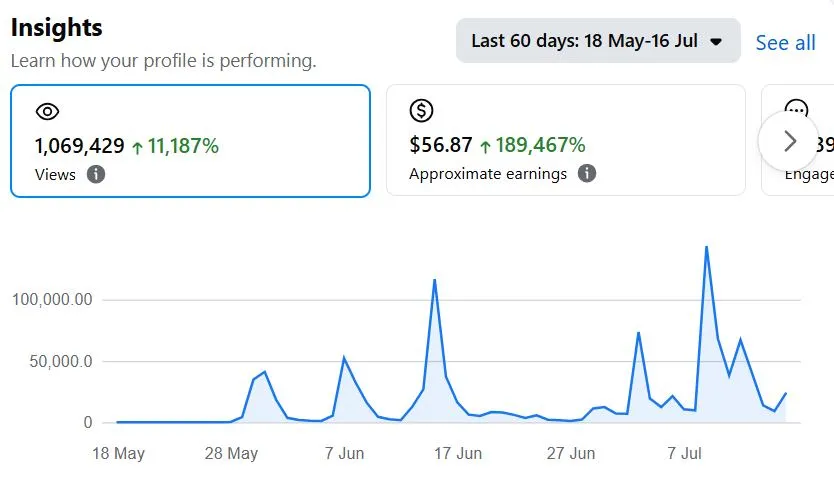
Yes, you read that right.
More than a million people saw my content, and the platform paid me 56 US dollars.
But after going through the data, I actually found it fascinating.
Because behind those 56 dollars is the real logic of the platform economy.
Finding one: viral doesn't mean money
I tried writing some election analysis, and some posts about the World Cup and football. These topics spread fast and go viral easily.
One election analysis got more than 80,000 views and earned just US$2.68.
Another post, about Entrepreneur Camp, got only 40,000-plus views and earned US$3.02.
Half the traffic, more money.
That's when I realised the platform doesn't simply pay for traffic. It pays for the advertising value behind that traffic.
Politics and football are things people love to read, so traffic is high, but advertising value isn't necessarily high. Business content spreads more slowly, but advertisers would much rather appear next to it.
Working it out, business content earned three to five times more per thousand views than political content.
Traffic comes from emotion. Revenue comes from advertising value.
Finding two: shares make money, likes don't
I ran an analysis on the data for every post.
At least in my 60 days of data, the correlation between earnings and shares was as high as 0.978, far higher than for likes.
Thinking about it, that makes sense.
When someone likes your post, the story ends there.
But when someone shares your article to their own Facebook, WhatsApp or a group, your content reaches a new audience and brings more impressions that can be monetised.
So the real question to ask when writing isn't "do people like it?"
It's:
"Will anyone forward it to their friends?"
Likes are people being polite. Shares are what bring in business.
Finding three: format matters more than you think
I tried different ways of posting.
The same kind of article, posted with a photo, earned on average US$0.043 per thousand views.
Text only: just US$0.026.
A 65% difference in earnings.
Even more extreme: three posts I published in another format had decent views, and earned exactly zero.
Not a cent. Same content, completely different money.
The only difference was a few choices made before pressing Publish.
Finding four: the algorithm's memory is shorter than you think
One week I wrote especially seriously and posted every day.
That week, overall reach looked great. Then I had a busy week and stopped posting regularly. The week after, overall reach dropped 90%.
From nearly 200,000 views in a week down to 20,000. The platform doesn't remember how popular you were last week.
It only looks at whether you're still giving it the content it wants this week.
Business is the same. Customers don't stay forever just because you served them well last year.
Finding five: strawberries
This is the one I find most interesting.
In these 60 days, guess which post earned the most?
Not Pinduoduo. Not Meituan. Not the election.
Strawberries.
The post analysing Driscoll's strawberry business model got 260,000 views and earned US$19.21.
One article made up a third of my total earnings for the 60 days.
After analysing it, I finally understood why it took off. It satisfied both sides at once.
The topic is a fruit everyone has bought and eaten, so the general public is happy to click.
The angle, though, is about variety IP, branding, supply chain and business model, so the advertising value is high too.
Mass topic × business angle.
It was the first time I saw traffic and revenue standing on the same side.
Content is the product
These 60 days weren't so much me writing on Facebook as me running an experiment.
The platform is the market. The audience is the traffic. Advertisers are the paying customers. Content is the product.
Your product can be loved by many people, yet nobody wants to pay for it.
Or it can be loved by fewer people, yet be very valuable.
The best product does both. Isn't that exactly the problem we face in business every day?
One lesson, US$56.
And it's the kind of lesson where the platform paid me to attend.
I'd say that's pretty cheap.