Never walk alone, cash is king, have a plan
Originally written in Chinese. Translated with AI, reviewed by Gary. Read the Chinese original →
Today NEXEA invited Harald Weinbrecht to talk about his journey as a founder.
Harald is German. He came to Malaysia to start a business around 1995. Back then, never mind AI, the internet itself was only just spreading. He built IT solutions here and went on to found several companies.
What's interesting is that his companies ended in different kinds of exits.
One company IPO'd in Malaysia, one was sold to a Japanese company, and one ended in a management buyout: once the company was running well, the original management and staff bought it and became the owners.
Today he's basically financially free, and spends more of his time on investing, mentorship and consulting.
Listening to the whole session, much of it wasn't some brand-new startup theory.
But perhaps precisely because he has really started, run and exited companies several times, a few of his lines landed especially hard.
He wrapped up with three lessons learned:
Never Walk Alone. Cash Is King. Have A Plan.
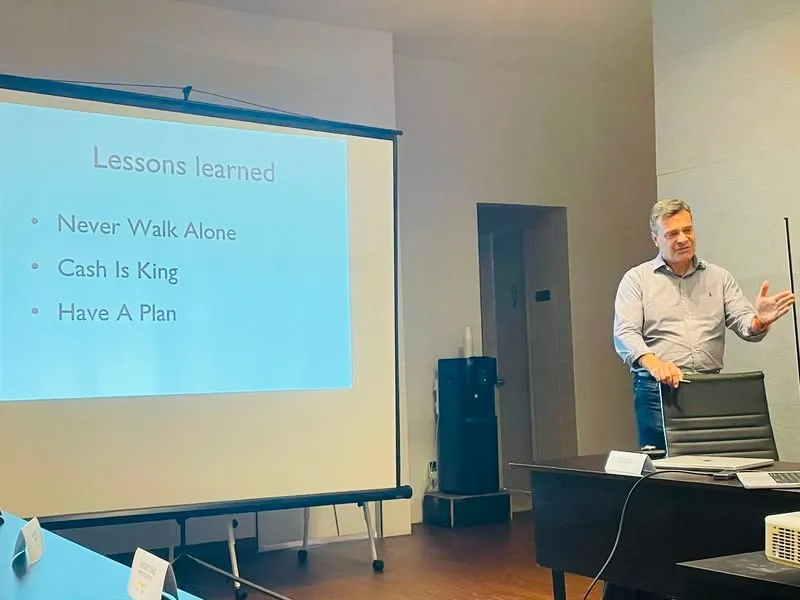
Never walk alone
He said that to build a company, you basically need three kinds of people.
The first is the visionary, the sales guy.
This person has to see the future, and be able to sell it.
The company may have nothing yet today, but he can make customers believe, investors believe, employees believe, even the whole team believe: "We really can make this happen."
The second is the operations, delivery guy.
Because having someone who tells a good story isn't enough. In the end someone has to turn the story into reality.
The customer said yes; who builds the product? Who delivers the project? Who manages the team? Who fixes things when they go wrong?
Vision can run far ahead, but operations has to walk it out, one kilometre at a time.
The third is the CFO, the finance guy.
This person may not be the best seller or the best at talking vision, but he must know where the money is, where the costs are, where the risks are, and how long the company can keep running.
I really like this view.
When we look at a successful company, we usually only see the founder speaking on stage.
Over time it's easy to fall into the illusion that a company was built by one person.
It wasn't.
A truly good founding team should be complementary by design.
One person looks far ahead, one makes it real, one guards the money.
Very few people can do all three really well at once.
So a startup has never been a one-person game.
Cash is king
The second line really hit home for me.
When running a company, we love looking at profit.
How much we made, what the margin is, how much we grew this year.
Go a bit further towards capital markets and people start talking valuation: what the company is worth.
But Harald said something very simple today:
Profit is vanity. Balance sheet is sanity. Cash flow is reality.
Profit on paper matters, and the balance sheet matters, but what a business actually lives on every day is cash.
Because at the end of the month, you can't pay salaries with your profit margin.
And the landlord won't let you pay rent two months late because your valuation is high.
Suppliers need paying, staff need salaries, the company has to keep running every day, and it all comes back to one thing:
How much money is actually in your bank account?
Harald said that from his years running companies, the P&L often involves accounting treatment. It can be adjusted, it can be arranged.
But cash is honest. If you have it, you have it. If you don't, you don't.
So whether a business can keep living often isn't about how much it makes on paper, but whether its cash flow can hold up.
It may sound basic.
But after years in business you realise the more basic something is, the easier it is to forget.
Have a plan
Why are you actually building this company?
Where do you want to take it?
What do you want it to be in five years?
Keep running it forever? IPO? Sell it? Hand it to management? Or become a company that runs on its own, no longer dependent on the founder?
Harald's own companies took completely different exit routes, so he stressed this point:
If even the founder doesn't know where the finish line is, the team doesn't really know where it's running either.
A plan doesn't mean the future will go according to plan.
In a startup, it almost certainly won't.
But at least you need to know roughly which direction you're heading.
Go try something stupid
Finally, there was a story I found very funny, and also very interesting.
Harald, being German, brought this startup philosophy into raising his kids and managing his teams.
He said that when his son was still young, he liked throwing him into problems he didn't know how to handle.
He'd even encourage them:
Go try something stupid.
Do some silly things.
Try things where you don't know the outcome.
Make mistakes.
Because if everything is arranged for someone, and every risk is blocked for them, it's very hard for them to really grow.
He shared a story: when his son was still quite young, he let him travel to Taiwan on his own.
His son asked: "But I don't know Chinese?!"
His thinking was simple:
You don't know it? Then figure it out.
Very German. 😂
But he manages staff with the same logic.
Management isn't controlling everything until there's no room for mistakes.
It's letting the team try things themselves, as much as possible, within the range of risk you can afford.
Let them make decisions, let them own the results, even let them make some mistakes.
Because many abilities aren't trained into people. They grow after falling down a few times.
Starting a business is often just like this.
Find a group of people with different strengths and walk together in a roughly known direction. Keep enough cash on hand so you don't die halfway. Then, within what you can afford, keep making attempts that might look a bit stupid.
Some will fail.
Some will look truly dumb in hindsight.
But occasionally one works, and it might become the next company, the next growth curve, even the next exit.
Maybe these are the simplest lessons left behind when someone who has been starting companies for decades boils the complicated world of entrepreneurship down.