Business wisdom hidden in a nasi kandar shop up north
Originally written in Chinese. Translated with AI, reviewed by Gary. Read the Chinese original →
In March this year, Hui Ge asked me to go up north with him to take care of some business.
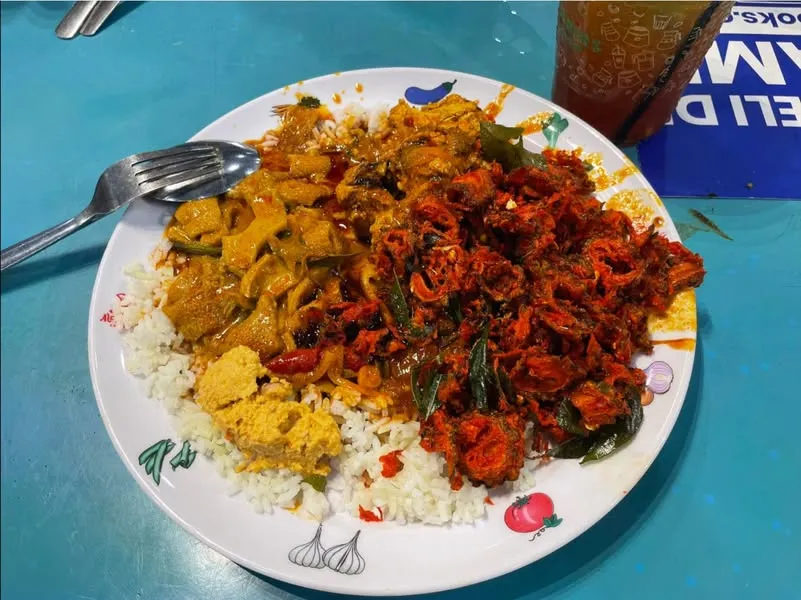
I took the train up. After we finished our work in Sungai Petani, we had a bit more time, so Hui Ge took me to eat at a nasi kandar place.
When we arrived, he said, a little mysteriously:
"Gary, experience it for yourself."
I thought, it's nasi kandar. Come up north, and of course you eat at the mamak, you eat nasi kandar.
But the moment I joined the queue, I noticed something was different.
Transparent pricing is respect
My first impression was: clean.
Not surface-clean. You could feel that the system itself was clean. Every bin had a lid, and the floor didn't have that greasy feel. While I was queuing, since nasi kandar always involves a wait, someone actually came over and served me bandung syrup.
Many restaurants assume you'll just put up with the queue. This one seemed to know you were waiting, so it took care of how you felt first.
Next, the prices.
What do we fear most when eating nasi kandar?
The surprise.
You feel like you only took a few dishes, then at the till it suddenly becomes a philosophical question: what exactly did I just eat?
Especially up north, everyone has heard plenty of nasi kandar stories. You finish eating, the price is unclear, and you feel uneasy.
But Hussain Nasi Kandar is different. Every dish has its price written up clearly.
Whatever you want to take, you can see for yourself. You know how much it costs before you take it.
It looks like a small thing, but it isn't.
Because in business, what matters most isn't how much you make. It's whether customers feel respected.
Transparent pricing is, at heart, a form of respect.
Once we sat down to eat, Hui Ge started telling me the story of the place.
He said he'd had the chance to get to know the owner and had talked with him. Even more unusual, Hui Ge had been inside their kitchen, and he showed me photos.
Honestly, I was a bit stunned.
Every ingredient, spice and condiment was sorted. Sealed in plastic containers, each one lidded and clearly labelled. What each thing is, where it goes, when it's used: you can see it at a glance.
I'm in e-commerce myself. We manage thousands of SKUs at the same time. To be honest, looking at photos of their kitchen, I felt a bit ashamed.
Because one restaurant's organisation, hygiene and labelling were clearer than many e-commerce warehouses.
A good system makes doing right natural
And their hygiene isn't a slogan.
Hui Ge also told me that many of their toilets and kitchen hand-washing points are foot-operated or sensor-activated. Nobody turns a tap on or off by hand.
Because a real SOP isn't words on a wall. A real SOP is when you've already thought through something as small as whether people's hands will touch a switch.
Often when we talk about hygiene, we just tell staff to be more diligent, remember to wash their hands, remember to clean up.
But a good system doesn't keep reminding people to do the right thing.
A good system makes it naturally easier for people to do the right thing.
There were many small details in the restaurant.
For example, if you feel your rice isn't hot enough, there's a microwave nearby. The restaurant is air-conditioned, yet there's no smell. When someone leaves a table, someone comes to clear it immediately. Only once it's cleared and tidied does the next group sit down.
And there are free drinks on the side.
Not sugary drinks, but healthier water, like lemon water and cucumber water. Next to them are written some Islamic principles and philosophy.
Hui Ge said the owner once told him: if you want sugary drinks, you can pay for them. But if you just need water, the restaurant can provide it for free.
You can eat here without buying a drink, and that's fine.
Many business people would think: if customers don't buy drinks, I make a little less. But his thinking seems different.
He doesn't design every spot as a monetisation point.
He leaves some places for kindness.
There's an even more remarkable story.
The owner has said that if anyone finds a cockroach or a rat in his restaurant, he'll pay them a thousand ringgit on the spot.
Of course, that line isn't just about paying out money.
It tells his staff: hygiene isn't only the boss's business. Hygiene is the responsibility of every person in the organisation.
Often when we talk about running a company, we talk about SOPs, KPIs, incentives and punishments.
But the hardest part isn't writing the rules.
The hardest part is getting the team to understand why it matters.
If a boss truly believes hygiene is part of trust, his staff will gradually understand too: this isn't a show for customers, it's the bottom line of how we do business.
We're used to looking at Pang Dong Lai and Haidilao in China, Japan's service culture, America's management systems.
Of course those are all very good.
But it turns out Malaysia has businesses like this too.
And not in Pavilion, not in KLCC, not anywhere fancy.
In Sungai Petani, at a nasi kandar shop.
Amanah, halal, barakah
I've remembered it ever since.
Because I've lived in Malaysia for so many years and I had no idea there was a restaurant run this way.
So I asked Hui Ge: with something this good, why doesn't the owner promote it heavily? Why hasn't he kept expanding? Why isn't it a nationwide chain?
Hui Ge told me the owner's philosophy.
The owner is a devout Muslim. He believes he should do as much as Allah guides him to do today. He doesn't necessarily need to deliberately expand across Malaysia, nor package himself as some great entrepreneur.
Founders of our generation are often trained to scale, to grow, to fundraise, to chase valuation, to exit. As if not expanding constantly means you have no ambition, and not telling a big enough story means you're not good enough.
But this nasi kandar shop gave me a completely different feeling.
Of course it's a business, with management, standards and profit.
But it doesn't make money greedily.
It makes money within a faith.
When I got back, I made a point of reading about Islamic business philosophy. Only then did I understand better why this restaurant felt so special.
Take amanah.
Amanah is a trust, and also a responsibility. Customers hand you their stomach, their body, their time and their money. You're not just selling a plate of rice. You're taking on a responsibility.
So prices must be clear, hygiene must be clean, ingredients must be handled well, staff must be disciplined, and customers must be able to eat with peace of mind.
Then there's halal.
When many people talk about halal, they think of ingredients, of what can or can't be eaten. That's important, of course. But I think at a deeper level, halal is also an attitude to running a business.
Don't cheat, don't blur prices, don't make money in unclean ways, don't let customers spend without knowing clearly what they're paying for.
So when I see a price on every dish, labels in the kitchen, hand-washing that needs no hands, tables constantly being cleared, I feel this isn't just ordinary cleanliness.
It's a business ethic.
Finally, there's barakah.
I think barakah is a concept well worth founders thinking about.
In business we easily look only at revenue, profit, growth, outlets and valuation.
But barakah isn't simply having more money.
It's more like whether that money carries a blessing. Whether the business gives people peace of mind. Whether employees are looked after. Whether customers are respected. Whether the boss himself can sleep at night.
Some businesses make a lot of money, but feel dirty.
Some businesses never become the biggest in the world, but feel steady, upright and blessed.
This is very different from the modern business world.
Modern business always talks about efficiency. Every inch of space must make money, every process must be maximised, every customer must be upsold.
But this nasi kandar shop showed me another possibility.
A business can be very efficient and kind at the same time. A boss can have high standards and not be greedy.
A restaurant can be very ordinary and still build trust very deep.
That day I didn't just eat a plate of nasi kandar.
I saw a business owner's values.
We often think business wisdom has to come from big companies, business schools, Silicon Valley or listed companies.
But real business wisdom can also be hidden in a nasi kandar shop up north.
A person can truly put his faith into the everyday details of his business.