An economics lesson from a Hong Kong taxi driver
Originally written in Chinese. Translated with AI, reviewed by Gary. Read the Chinese original →
I got back from Hong Kong yesterday. Before leaving, I took a taxi from the hotel to the airport.
The moment I got in, the driver started chatting.
"Where are you from?" "Malaysia." "Going home?" "Yes."
A perfectly ordinary exchange, except this guy really loved to talk. The ride to the airport was nearly an hour anyway, so I thought, OK, if you want to chat, let's chat, and I can ask a Hong Konger what he really thinks of Hong Kong these days.
As we talked, it turned out this taxi driver's background was more interesting than I expected.
He owns two salons, barber shops basically, near Kowloon City. Rent in Hong Kong is expensive, so both shops are upstairs units. Someone else runs the business for him, so as the owner he doesn't need to stand in the shop cutting hair every day. He happened to have a taxi licence from before, so when he has nothing on, especially around eleven or twelve in the morning when the salons have few customers, he goes out and drives.
I found that hilarious.
The man taking me to the airport wasn't just a taxi driver. He was a small business owner with two shops.
Twenty-something pupils in a class
So of course I started asking about business.
"How do you think Hong Kong's economy has been these past few years?"
What followed, naturally, was a long round of complaints.
He said the past ten years have been genuinely tough for Hong Kong: weaker consumption, lots of people emigrating, a shrinking population. One detail stuck with me. He said his daughter's primary school now has only twenty-something pupils in a class.
He said people used to queue to get into these schools. Now there are fewer and fewer pupils.
That really resonated, because Chinese primary schools in Malaysia have slowly been seeing something similar. When I was a kid, thirty or forty pupils in a class was normal, some had over forty, and schools ran morning and afternoon sessions. Now twenty-something pupils per class seems increasingly common.
Population is a fascinating thing.
When the economy is bad, the first things people notice are poor business, shops closing and property prices falling. But changes in population structure are slower and go deeper.
Ten fewer pupils in a primary school class today doesn't look like much. Ten or twenty years later, it means fewer young consumers, fewer people marrying, fewer people buying homes, and possibly fewer people starting businesses and opening shops.
Rather empty than cheaper
Then we got onto Hong Kong's commercial property.
I found this part especially interesting.
He said that for a lot of commercial property in Hong Kong, rental income is a very important reference when banks do their valuations.
Say a shop rents for HK$30,000 a month. The market might value it at HK$10 million. The owner can mortgage it with the bank and borrow HK$5 million, HK$6 million, even HK$7 million.
Here's the problem.
Once the economy turns, the rent the market can actually bear may no longer be HK$30,000. It may be HK$20,000, or even HK$10,000.
A normal business person would think: then just cut the rent.
Nobody will pay HK$30,000, someone will pay HK$10,000. Surely that's better than leaving it empty.
But he said many landlords refuse to cut.
Because once the rent actually comes down, the bank revalues the property. What was worth HK$10 million may now be worth only HK$7 million. The bank that lent you HK$7 million may, after recalculating, only be willing to lend HK$5 million.
What about the HK$2 million in between?
The landlord may have to find a way to top it up himself.
So you end up with a very strange situation.
It isn't that nobody wants to do business, or that there are no tenants at all. Market rents for many properties have already come down, but landlords would rather leave them empty than formally lower the rent.
So I asked him: if a shop at HK$30,000 can't find a tenant, but at HK$10,000 someone might move in right away, right?
He said, yes, exactly.
The problem is the landlords don't want to cut.
Then you see a very troublesome cycle.
A street of ten shops starts with only two empty.
Those two landlords don't cut rent, so they stay empty.
Slowly it becomes three, then five.
With fewer shops, foot traffic starts to fall.
With less foot traffic, the shops still open find it harder and harder, until the sixth and seventh close too.
In the end, a street that once had commercial value loses more and more of it overall, because everyone was protecting their own valuation.
I think this is well worth thinking about.
Because from a single landlord's point of view, refusing to cut rent is actually very rational.
If cutting rent hits the valuation, and a lower valuation hits the loan, maybe even forcing him to put in his own cash, of course he'll hold on as long as he can.
The problem is that when a system leads everyone to hold, the market as a whole can't complete normal price discovery.
The invisible hand and the system
So I asked him:
"Then what do you think should be done?"
His answer was quite interesting too.
He said the market should just find its own way.
If you can't get HK$30,000, drop to HK$20,000. If nobody takes HK$20,000, adjust again.
Businesses that can work will stay, and those that can't will be weeded out. Prices should follow real supply and demand, not be propped up artificially.
I strongly agree with that.
It's essentially Adam Smith's invisible hand.
The market should let demand and supply find their own equilibrium.
If a place is only worth HK$10,000 in rent today, forcing it to stay at HK$30,000 won't make it worth HK$30,000 again.
It just makes transactions disappear.
And once transactions disappear, shops don't open, foot traffic is gone, the ecosystem gets weaker and weaker, and in the end the place may not even be worth HK$10,000.
But I think there's another, more important issue here.
If the real reason landlords won't cut rent isn't that they refuse to accept the market, but that the banks' valuation mechanism makes them afraid to, then what needs adjusting may not just be the landlords, but the whole logic of valuation.
If banks use current rent too directly to decide a property's value, so that a landlord who cuts rent immediately faces a lower valuation, a recalculated loan and maybe a cash top-up, then the system itself is creating an incentive against price discovery.
The market is already telling you the rent should be HK$10,000, yet the financial system forces everyone to keep pretending it's worth HK$30,000.
Then the problem in the end isn't that the free market failed. It's that the system itself is stopping the market from adjusting normally.
So if you really want to fix it, the answer may not be the government telling landlords "you must cut rent", or launching yet another policy to prop up rents.
Instead, banks and the whole financing system need to rethink:
How should a commercial property's valuation be calculated so that a short-term rent adjustment doesn't leave landlords with no room at all to face the real market?
This is what I find really interesting about economics.
Often, when we see a price that doesn't make sense, we assume one side is being greedy.
Landlords won't cut rent, so landlords are greedy.
Banks won't give room, so banks are bad.
But when you really break it down, you find that many people are making the most rational decision within the incentives they already face.
The real problem often isn't that one person did something wrong. It's that the system, once designed, leads everyone to make "the most reasonable decision for themselves", and the result is the worst one for everyone as a whole.
The market just tells you what it's worth today
Building a business is the same.
Often what we find hardest to accept isn't that the market has no answer. It's that the answer the market gives isn't the one we want to hear.
We think our product should be worth RM100; consumers will only pay RM50.
We think this store should do RM1 million a month; in reality it can only do RM300k.
We think this used to make money, so why not today?
But the market has no obligation to respect our historical costs, our valuation, or even our pride.
The market just keeps telling you:
What this thing is worth today.
You can accept it and adjust, or refuse and keep holding.
But in the end, the invisible hand will still slowly give you the answer.
This Hong Kong trip didn't have any special business meetings.
Instead, it was in a taxi on the way to the airport, with a man who owns two salons and drives a taxi in his spare time, that I spent nearly an hour talking about Hong Kong's economy, population, commercial property and banks.
Sometimes the best part of travelling really isn't how many sights you see.
It's getting into a random car, meeting a stranger, and suddenly seeing economics from a completely different angle through his world.
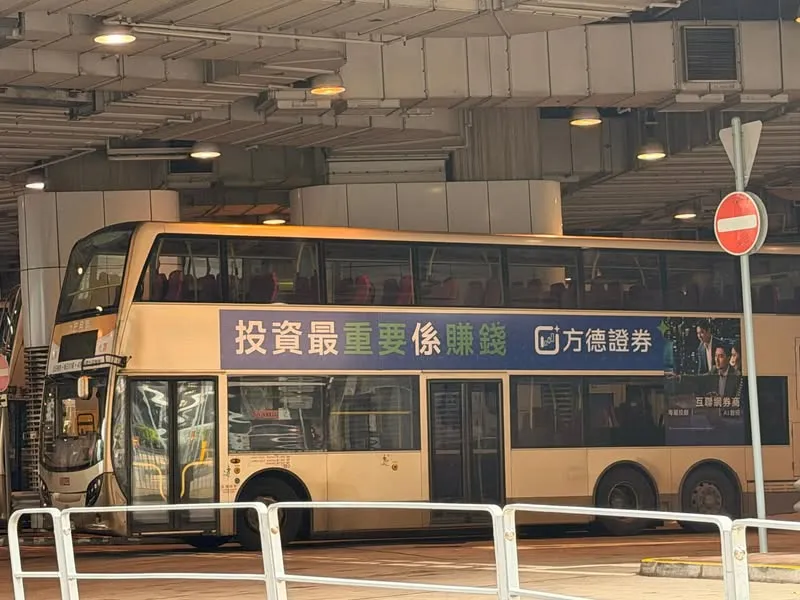
On the way I also spotted a funny bus ad. Hong Kong is that blunt about money: "The most important thing about investing is making money!" Impossible to argue with.