Grab never just bought a supermarket
Originally written in Chinese. Translated with AI, reviewed by Gary. Read the Chinese original →
This morning I went grocery shopping and slipped off to the toilet halfway through. Walking past Jaya Grocer, I happened to see a GrabMart Pick-Up Point.
It was only 10:30 am, and it was already busy inside. Staff were picking, packing and preparing orders non-stop. There were probably thirty or forty orders moving through, maybe more.
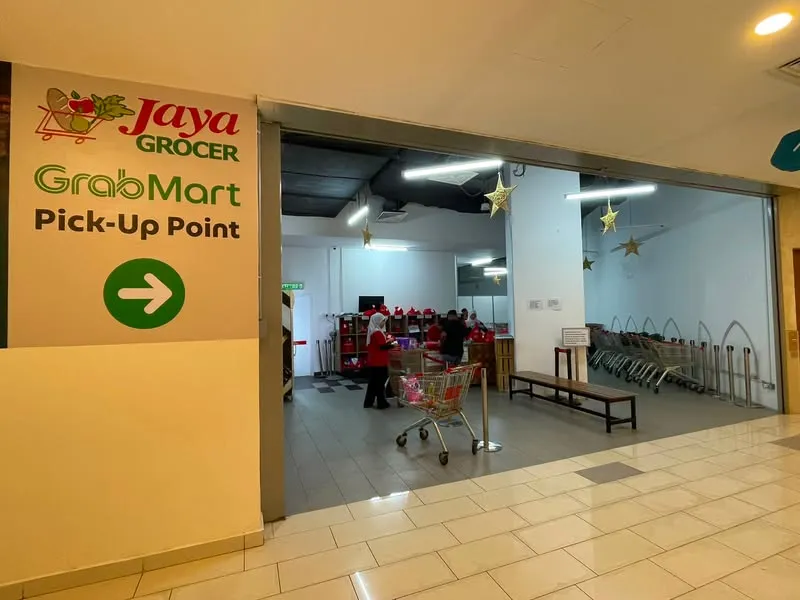
I stood there watching for a while, and suddenly remembered Grab's acquisition of Jaya Grocer a few years ago.
Back then, nobody got it
In December 2021, Grab had only just listed on Nasdaq through a SPAC, a deal that brought the company about US$4.5 billion. Less than two weeks after listing, it announced it was buying Jaya Grocer.
Market talk at the time put Jaya Grocer's valuation at around RM1.5–1.8 billion. Grab's filings later disclosed a consideration of US$227 million for a 75% economic interest: US$181 million in cash and US$46 million in Grab shares.
A lot of people didn't understand it at the time.
Why would a technology company still losing huge amounts of money, freshly listed with a big pile of cash, suddenly come to Malaysia to buy a supermarket?
There was plenty of doubt: was Grab a technology platform, or was it going into traditional retail?
Later I heard some interesting behind-the-scenes stories.
A friend who knew the management at the time told me integration was harder than expected after the acquisition. Some of the original management left, and Grab had quite a headache.
That's not hard to imagine.
A company built on apps, algorithms, delivery and payments suddenly had to manage fresh food, inventory, merchandising, buyers, suppliers and store operations. A completely different world.
Inventory close to the consumer
So why did Grab still buy it?
One very important reason was Jaya Grocer's supplier network.
Jaya Grocer already had deep relationships with a large number of FMCG brands and distributors. Today it has 61 supermarkets, more than 42,000 SKUs, about 1,100 suppliers and over 2 million loyalty members.
Plenty of distributors have stock. They know Nestlé, Unilever, P&G and F&N, and may even get very good purchase prices.
But they lack one thing:
Inventory that sits close to the consumer.
A traditional distributor's warehouse is in an industrial area, designed for cartons, pallets and B2B distribution.
Jaya Grocer's stock, on the other hand, was already sitting in shopping malls, residential areas, right inside consumers' daily lives.
After buying it, Grab plugged in its own:
Demand, Payment, Loyalty, Delivery, Data
layer by layer.
What used to be a supermarket slowly became a fulfilment centre right next to consumers.
Part of that expensive mall retail space is no longer for walk-in customers to browse. It's used to pick, pack and fulfil GrabMart orders all day.
And it really did take off, slowly.
In 2022, the first year after the deal closed, Jaya Grocer contributed US$334 million in revenue and US$11 million in profit after tax to Grab.
By 2023, Grab had increased the number of Jaya Grocer stores on GrabMart from about 12 to 41, and the online share of sales grew tenfold in a year.
In 2024, Jaya Grocer's GMV grew another 18% year on year. Since the acquisition, GrabMart transactions in Malaysia have grown 77%, and Jaya Grocer has become GrabMart Malaysia's biggest merchant.
It's even clearer today.
On a 2025 earnings call, Grab's management said close to 15% of Jaya Grocer's GMV now comes from online.
In other words, after Grab plugged its ecosystem into Jaya Grocer, nearly RM15 of every RM100 of Jaya Grocer GMV now comes through online channels.
From almost nothing before the acquisition to nearly 15% today: that's a big shift.
And Grab didn't stop there.
It went on to buy Everrise as well.
That's why, looking back at this acquisition now, I think what Grab bought was never just a supermarket.
It bought supplier relationships, inventory, locations, fulfilment capability, and the layer of the supply chain closest to consumers.
Then it plugged in what it was already best at: demand, riders, payments, loyalty, data and advertising.
Looking back years later
A few years ago, people were still arguing:
Why would a tech company buy a supermarket?
Did it overpay?
Could management integrate it?
Years later, I simply went to the toilet, walked past, and saw people fulfilling orders non-stop at ten-something in the morning.
And I realised that a move which looked strange at the time had, years later, slowly been made to work.
Business is often like this.
At the start, everyone has an opinion: is the strategy right, is the valuation too high, is management up to it?
But what really matters is looking back years later: did someone actually get the hard, tedious, unsexy work done, bit by bit?
The Grab and Jaya Grocer case had so much controversy and went through so many integration problems.
I didn't expect that, a few years on, they would really make it work.
That's what makes building a business so interesting.