Every good company starts with two people
Originally written in Chinese. Translated with AI, reviewed by Gary. Read the Chinese original →
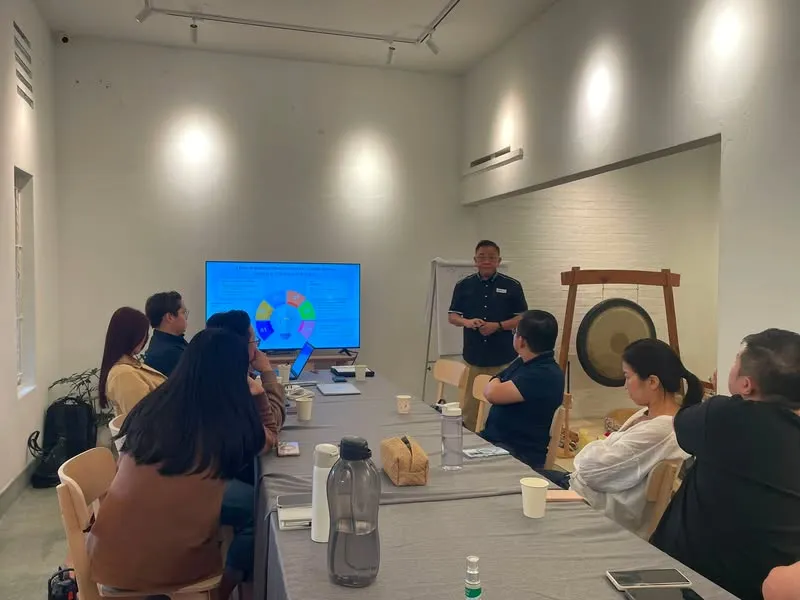
Let me start with a talk at yesterday's MPEA (MyStartr Post ECF Accelerator) that really stayed with me.
This time 文彬大哥 (Brother Wenbin) invited 陈文翰 (Mr Chen Wenhan) of CAS Global to talk about internal control. I expected a very "accounting" class: compliance, governance, SOPs, the hard stuff. But afterwards, what I remembered wasn't the technical knowledge. It was two very simple stories.
The doctor said: you will die one day
The first story was very funny.
He said that in the nineties he went for a health check that cost a few thousand, which wasn't cheap. Before the check, he half-jokingly asked the doctor: "Doctor, can the report I get later say there's nothing wrong?"
The doctor smiled and replied:
"I can confirm you will die one day."
The whole room laughed.
But he said this is actually the most important idea in internal control.
There's no person who never makes mistakes, and no company that never makes mistakes. Fortune 500 companies make mistakes, listed companies make mistakes, and startups make even more. Internal control was never about creating an organisation that never errs. It's about accepting that people will make mistakes, and using systems, processes, SOPs and governance to reduce the chance of errors and minimise the damage when they happen.
Many founders, including me in the past, think a good company should get everything right. After years of running businesses, I've learned it doesn't. A truly good company isn't one that never makes mistakes. It's one that keeps moving forward after making them.
Every company starts from two people
The second thing that struck me was what he said about org charts.
Many founders ask: we're only a few people, do we really need to draw a CEO, COO, CFO, CMO and CTO?
His answer was simple:
Every company starts from two people.
That's how every company begins.
No marketing today? The founder does it. No finance? Read the P&L yourself. No HR? Hire people yourself. No customer service? Answer the WhatsApp messages yourself.
When the business grows and needs that role, add a person. Grow more, add a department.
No company is a complete organisation on day one.
A makeshift stage is where you start
On the way home yesterday, I thought of a phrase that's been popular on the Chinese internet in recent years:
"The world is one giant makeshift stage." (In Chinese, 草台班子: a troupe performing on a hastily built stage.)
When many people first see it, they read it as mocking how chaotic the world is.
But I think what it really says is something else.
Don't imagine others are perfect.
The big companies, the listed companies, the Fortune 500, even the people you admire most: they make mistakes too, hold pointless meetings too, make wrong decisions too, and fix things as they go.
A lot of things aren't as magical as you imagine.
But I prefer another reading of the phrase that came later.
A makeshift stage isn't the end. It's the starting point.
Nobody starts on the big stage.
Every great company once had only two or three people. Every mature organisation was once chaotic. Every well-built system was built after countless mistakes.
That's what's most fun about starting a business.
You don't wait until everything is ready before you begin. You begin, and then slowly turn a makeshift troupe into a truly professional team.
So when someone says the world is just a makeshift stage, I don't hear mockery. I hear a reminder.
Don't think you can't start just because others look impressive. And don't doubt you can become professional just because you're still makeshift today.
Because every good company started with two people.
And the world has always worked this way: making mistakes, growing, and slowly building the makeshift stage into a real one.