400 CNY songs isn't a glut. It's budget on the move
Originally written in Chinese. Translated with AI, reviewed by Gary. Read the Chinese original →
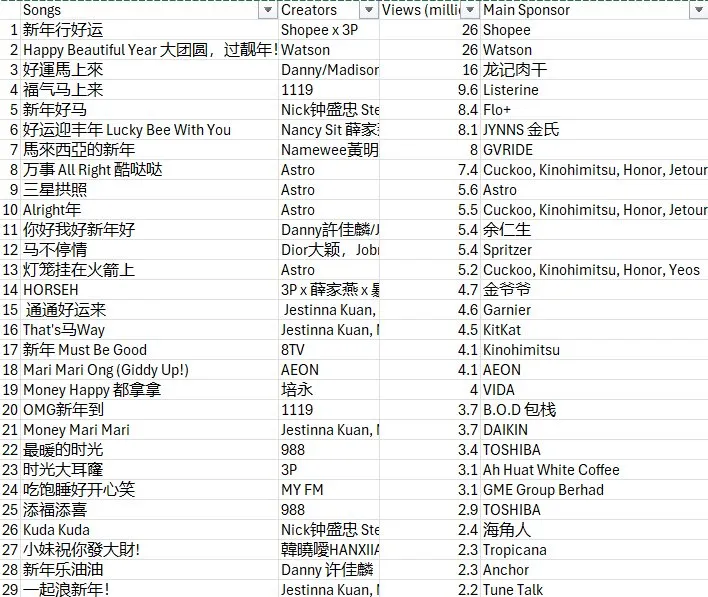
Malaysia had roughly 400 new Chinese New Year songs this year.
Feels like a glut, doesn't it?
But look at it from a slightly different angle and it's actually quite interesting.
Have you ever seriously asked: without a paying client, how many people would fund a CNY song music video out of their own pocket? Friends of mine who make content say a decent CNY song easily costs six figures to produce. Many people frown at that number: is it really worth spending six figures on a New Year song?
From the client's side
The answer only makes sense from the client's side.
Take a fast-moving consumer brand. Suppose a brand like Listerine does around RM200 million of business a year in Malaysia. If it puts 10% into marketing, that's a RM20 million budget a year. This isn't money it can choose whether to spend. It has to be spent. If a brand stops showing up, consumers soon forget it, distributors start losing confidence, and competitors may slowly eat its shelf space.
Marketing has never been just icing on the cake. It's a kind of "existence tax", the cost of staying relevant.
It's just that the media are changing. Brands used to buy newspapers, magazines and TV, but impressions on those channels are visibly falling. The budget hasn't disappeared. It has migrated to social media.
Many people think six figures for a YouTube CNY song is expensive. But compare it with highway billboards at RM40k to RM60k a month: put up a few across several highways and you're quickly at six figures, and when the time is up, the ad simply disappears.
A creative CNY song that reaches a million views, though, may have a life cycle of ten years or more. It spreads in 2026, people replay it in 2030, and in 2036 someone may still dig it up. In essence that's no longer an ad. It's a content asset with a long tail.
So you'll notice that this year brands have been especially willing to bet on YouTube CNY songs and influencer MVs, not just short videos. Short videos are traffic. A New Year song is a memory point that can settle and stay.
A fat year for creators
The other side, the creators, is even more interesting.
When budgets are looking for an outlet, creators in their striving years naturally jump in with everything they've got. You'll see a very obvious pattern: Pei Yong, 3P, the Jestinna Kuan family and Danny (许佳麟) all appeared in different CNY songs almost at the same time in 2026.
In a way, quite a few influencers really did have a "fat year".
Brands are fighting for exposure, creators are harvesting production fees, and platforms are feeding on the traffic. On the surface there are more CNY songs. Underneath, marketing budgets are being reshuffled.
Zoom out a little further and you feel it more.
Astro's market value recently came to around RM391 million, while Foodie, a comparable new-media company, is around RM390 million. On past assets alone, Astro wouldn't necessarily lose. But capital markets never look only at history. They look at how attention will be allocated in the future.
And honestly, the imagination around influencer distribution is still far from fully opened up. That's why the market is willing to give new media higher expectations.
A practical observation
Finally, one very practical observation.
If you want to break into "influencer CNY songs" next year, the easiest clients to win are clear: fast-moving consumer goods brands. They must keep spending, they face heavy channel pressure, and their annual marketing budgets are relatively stable. As long as your content is memorable and your reach is wide enough, they are always looking for new outlets for exposure.
So this year's CNY songs aren't a glut.
They're more like a signal: brand budgets are moving systematically into content assets.
And this has only just begun.