Chongzhen's bell: when nobody comes
Originally written in Chinese. Translated with AI, reviewed by Gary. Read the Chinese original →
Today I visited the Forbidden City with my family.
It really is beautiful, and really huge. The palaces and the central axis tell you, all by themselves, what the peak of an era's imagination looks like.
Afterwards we went to Jingshan Park. I only meant to look at the Forbidden City from above, but on the south slope I noticed a stone tablet.
Up close, I realised this was where Chongzhen, the last emperor of the Ming dynasty, died for his fallen country.
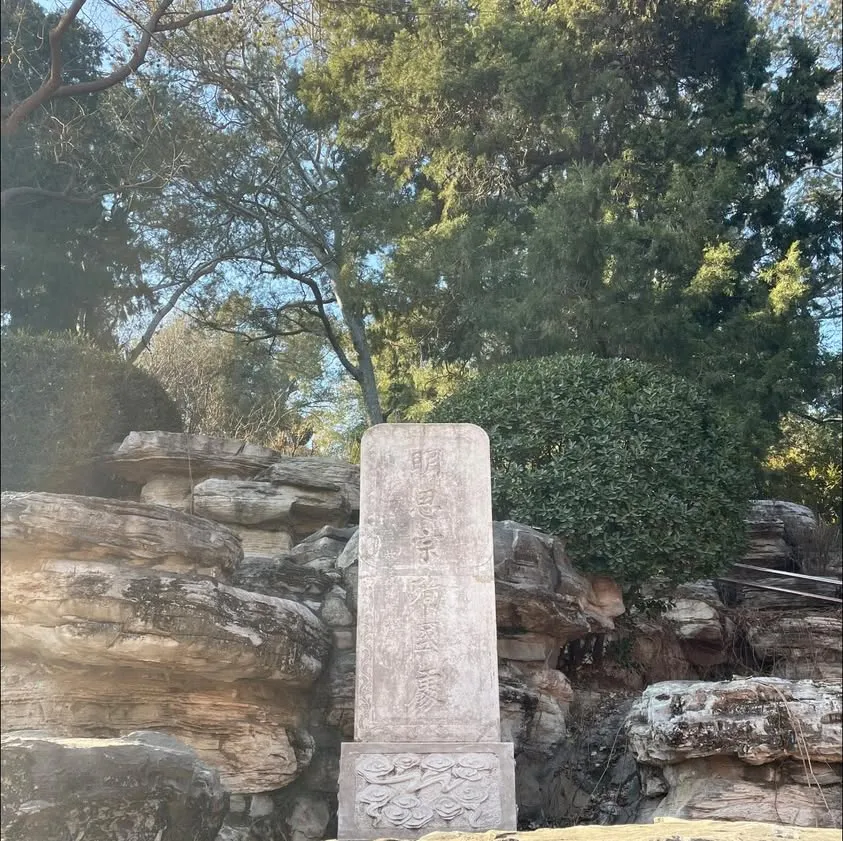
It caught me by surprise. For someone who grew up watching palace dramas like The Flower Princess, I felt an odd kind of excitement I can't quite explain. History suddenly stepped out of the books and off the screen and became the ground under my feet.
He wanted to do it all himself
Chongzhen has always been easy to misunderstand.
He wasn't the typical last-emperor type. On the contrary, he was diligent and frugal, not given to women, did everything himself, and dealt with state affairs almost every day. Judged by attitude alone, he looked more like a leader who genuinely wanted to get things right than many emperors of prosperous times.
But that's exactly where the problem was.
He wanted too much to save everything by himself.
He was smart, quick and responsible, but also stubborn, suspicious and impatient. He wanted to control every decision and fix every problem at once, and everyone around him had to fit his judgement and pace.
Over time, the people who could really get things done were worn down, good people didn't stay, and trust slowly collapsed. In the end, the whole system still looked like it was running, but really it was just him, alone in the middle, holding it up.
Nobody came
In 1644, Beijing fell.
He tried to slip out of the city disguised as a eunuch, and failed. Then, before dawn, he went up to the main hall and rang the bell to summon his officials.
The history books record it coolly, and cruelly: not a single person came.
That scene is even more heartbreaking than his final choice to take his own life.
What really brings an organisation to its end is often not an outside enemy. It's the day you discover that, when you need people most, nobody is willing to stand with you any more.
Chongzhen didn't fail for lack of effort. He failed because of an illusion many founders know well: if I just push a little harder, watch a little closer, carry a little more, we'll get through.
Reality is usually the opposite.
When a system has already been overdrawn, emptied out, or has failed structurally, heroics only speed up the collapse. The more you carry it alone, the clearer it is that the system has stopped working.
Interestingly, after the Qing entered Beijing, they turned this spot into the so-called "guilty locust tree". They put an iron chain on the tree, and officials passing by had to dismount and walk. On the surface they were punishing the tree; really they were telling a story: your emperor wasn't incompetent, he was driven to his death.
Later, during the Cultural Revolution, the site was smashed and repudiated, and much of it disappeared for a time. Many years later, it was put back up again.
The same place, in different eras, has kept being given different meanings.
If Chongzhen were a founder
If you look at Chongzhen as a founder, his biggest mistake wasn't getting a judgement wrong once or twice. It was realising too late that this game could no longer be saved by him alone.
Building a business is the same.
The real risk often isn't a bad environment, a falling market or fierce competition. It's that you're still using personal willpower to prop up a system that needed redesigning long ago.
Some failures don't happen suddenly. You just kept refusing to admit that the road had already come to an end long ago.