How bad is Malaysia's retail market, really?
Originally written in Chinese. Translated with AI, reviewed by Gary. Read the Chinese original →
Let's set aside whether these companies make or lose money. Today I want to look at market confidence.
I looked at a few listed retailers I know well and put their highest share price over the past 52 weeks next to their price in the last couple of days. Only then did I see how big the drop really is.
99 Speed Mart in groceries, MR D.I.Y. in household goods, budget chain Eco-Shop, Padini in clothing, AEON in department stores and supermarkets, and Senheng in electrical appliances. Measured from their respective highs, these six companies have together lost about RM17.3 billion in market value.
99 Speed Mart and MR D.I.Y. alone lost about RM8.3 billion and RM6.1 billion respectively. Padini's share price has nearly halved, and Senheng has fallen by more than half. (Full data in the table below.)
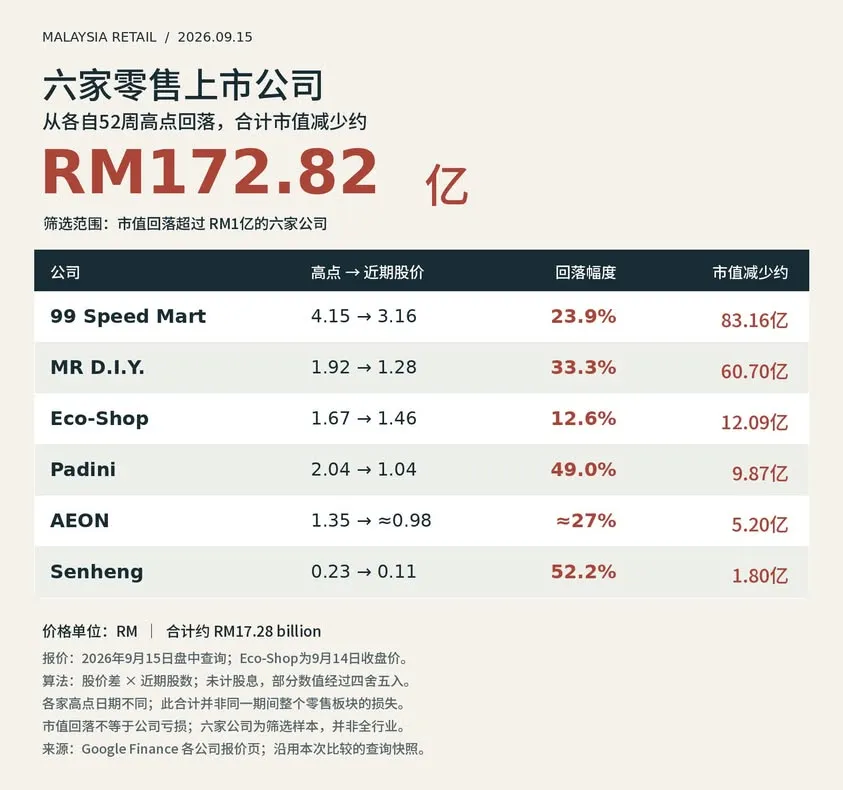
Of course, this doesn't mean the six companies lost RM17.3 billion, or that any bank account actually shrank by that much. Each company hit its high on a different date, so the figure is the sum of separate declines.
But what bothers me is this: the price the market is willing to pay for these retail businesses is now much lower than at the peak.
People running businesses look at orders and this month's sales every day. Investors are also buying expectations for the next few years. A company can keep making money, but if the market thinks future growth won't be as fast, or that making the same money will get harder and harder, the valuation it's willing to give may come down.
These six companies can't represent the whole retail industry, but they give us a signal worth thinking about: the stores are still there and the signboards haven't changed, but the market has repriced their future.
Was the market too optimistic before, or is it too pessimistic now? Or is the retail business going through changes we haven't fully seen yet?